
When Life Changes Faster Than You Can Process It
What if your exhaustion isn’t coming from doing too much, but from processing too much?
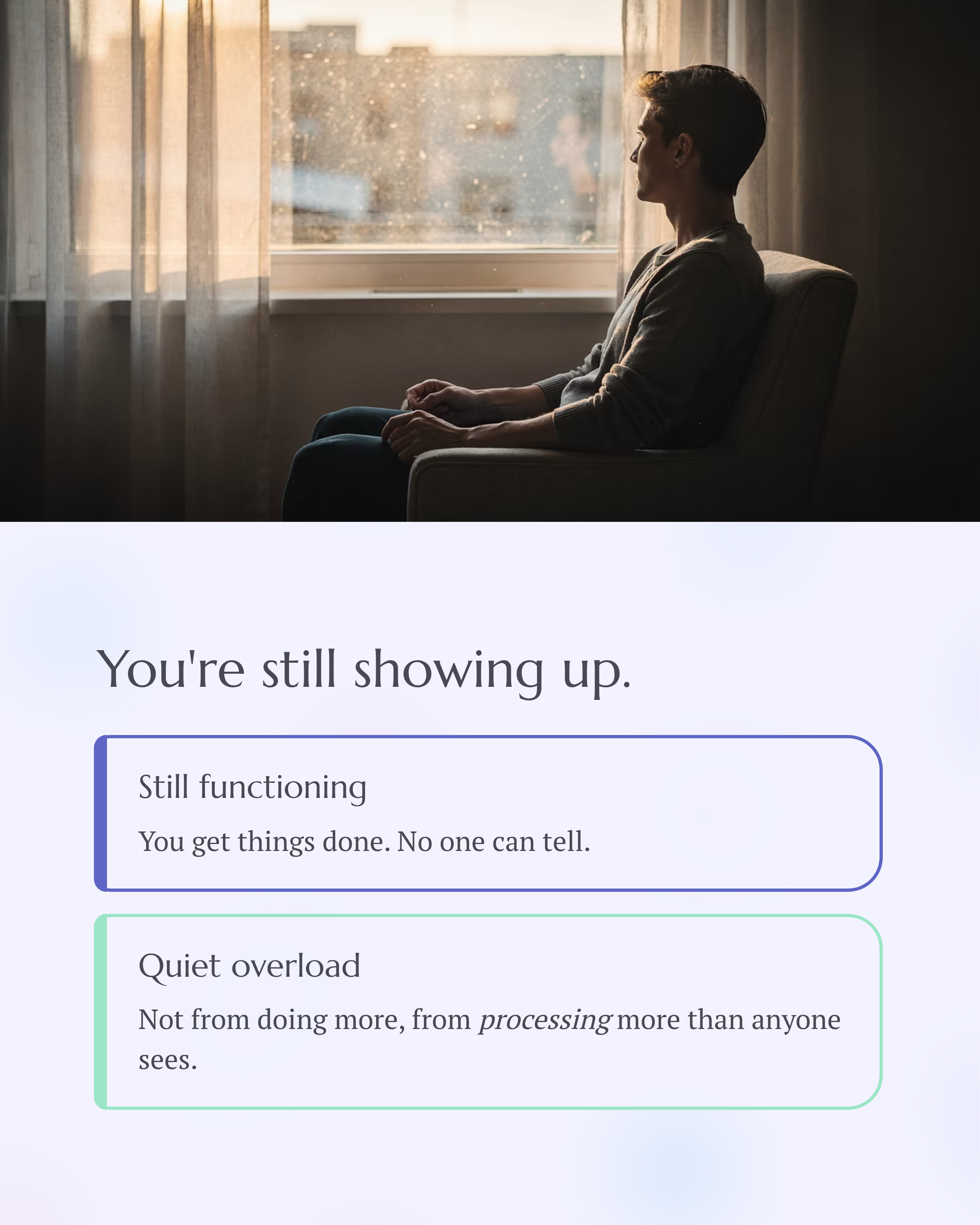
There’s a kind of exhaustion that doesn’t come from overworking.
It comes from adapting, translating, carrying, and processing, all day, every day.
The Exhaustion That Isn't About Your To-Do List
You're not failing at your job. The feedback is fine. The projects get done. At home, things are stable, no major crisis, nothing you can point to. But after hours, when the Slack notifications fade, when the house is quiet and you're left with just yourself... something feels off. And you can't quite name it.
It's not a collapse. There's no single breakdown moment. It's more like a low, steady whisper of “Is this it?” A tiredness that follows you from bed to desk to dinner, never quite lifting.
You've moved countries, changed jobs, built a new life. You've done everything “right.” So why does it feel like you're running on a treadmill that's just slightly too fast, not so fast you fall off, but fast enough that you never get to just stand?
This is a different kind of exhaustion. It's not from working harder. It's from processing harder. Your mind is working overtime, not just to solve problems, but to translate a life that changes faster than your nervous system can keep up with.
Here are a few quiet places this shows up.
When Rest Doesn't Reach You
You sleep. Maybe enough hours, on paper. But you wake up feeling like you haven't slept at all. Your body is still waiting for something.
This isn't about counting sheep or cutting caffeine. It's your nervous system staying on alert, scanning for the next unexpected thing, the cultural nuance you didn't see coming, the work email that needs a different tone, the social cue you're still learning. You're resting your body, but your brain is still running, still translating, still trying to belong.
Reflection: When you wake up tired, what is your body still waiting for?
The Two Speeds of Your Mind
At work, you're sharp. You problem-solve, you prioritize, you deliver. But the moment you step away, your thoughts scatter. Brain fog. Indecision about what to eat for dinner. A loop of replaying a casual conversation, wondering if you said the wrong thing.
It's not that you've lost your intelligence. You've just run out of bandwidth for the non-work parts of life. All your cognitive energy went to performing “competent expat professional” for eight hours. There's nothing left for you.
Reflection: Where do you notice your mental sharpness disappears first?
The Snap, Then the Guilt
A small thing happens. A partner asks a simple question. A child makes a mess. A friend changes plans. And you react, sharply, more than the moment deserves. You see the hurt in their eyes and instantly feel the shame.
You weren't angry at them. You were exhausted. But exhaustion looks like anger when you've been holding it in for too long. The cycle “snap, feel guilty, withdraw, then snap again,” isn't a sign you're a bad person. It's a sign you've been running on empty and no one told you.
Reflection: What's one small recent moment where your reaction surprised you?
What We Show, What We Carry and What's True
There's what we say out loud, what we carry quietly, and what's actually true underneath it all.
Maybe for you, it looks something like this:
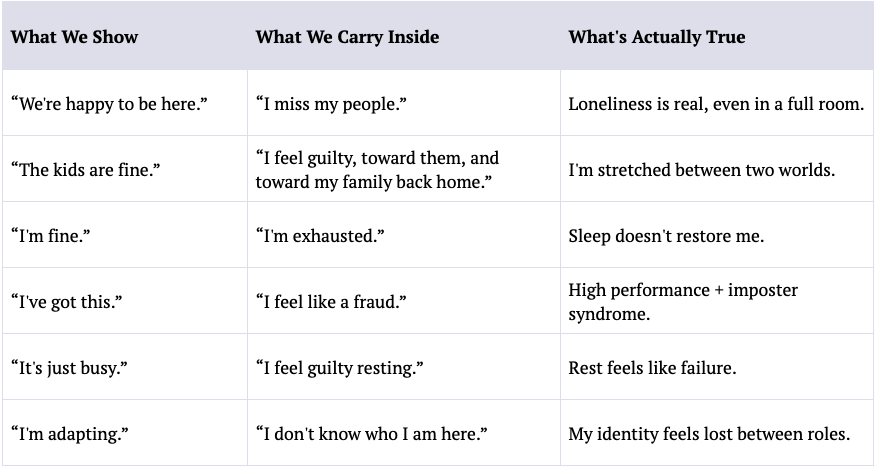
You're not being dishonest by showing the first column. You're surviving. But if the second layer (what we carry inside) never gets seen, even by you, it starts to weigh more than the first.
The Stories That Keep You Stuck
Underneath the exhaustion and the invisible load, there are beliefs we don't even realize we're holding. They felt like fuel at first. Now, they feel like walls.
"I need to earn my place here."
"If I slow down, I'll fall behind."
"Rest is for when everything is done."
"Asking for help means I've failed."
These aren't character flaws. They're survival stories, strategies that helped you get here. But at some point, they stop protecting you. They just keep you running.
Reflection: Which of these stories have you been believing without questioning?
What Actually Helps (Not More Hacks)
If you've been looking for a checklist, a 5-step plan, or a "productivity hack" to feel better, this isn't it. Because you don't need to do more. You need to slow down enough to feel what's already there.
Noticing, not fixing. The first step isn't to change anything. It's just to notice. "Oh, my shoulders are up by my ears again." "There's that sudden impatience." "I felt relief when that plan got canceled." Just noticing, without judgment, is how you start to see the pattern.
Pausing before pushing. When you feel the urge to work through lunch, scroll instead of sleep, or say yes to yet another thing, pause for 60 seconds. Ask: "What do I actually need right now?" Not what you should need. What you actually need.
Getting curious, not critical. When guilt shows up for resting, instead of "Why am I so lazy?" try "What is this guilt trying to tell me? That I'm afraid of falling behind? That I learned that rest isn't allowed?" Curiosity softens the shame.
These aren't quick fixes. They're small acts of rebalancing. And over time, they change the way you move through your life.
When You're Ready
If any of this felt familiar, the tiredness that doesn't fade, the pressure you can't name, the quiet drift away from yourself, you don't have to figure it out alone.
You're not broken. You're not weak. You're just carrying something heavy without a place to set it down.
If you're wondering what to do next, you don't have to have the answer yet. We can simply talk about where you are and what's been feeling heavy.
No pressure. No preparation. Just a conversation to see whether support could be helpful.
Free 45-minute conversation. No preparation. No pressure.
Disclaimer: This writing is for awareness and reflection. It is not a substitute for medical advice, diagnosis, or treatment. Physical symptoms, persistent low mood, or major changes in sleep or appetite always deserve a conversation with a healthcare professional. This work complements medical care; it does not replace it.
