
Burnout: Understanding It, Moving Through It
Written by Mena Eissa, Coach & Mental Wellbeing Counsellor for Tech Expats. Diploma in Coaching and Counselling, registered with LVSC. Read Mena's story.
Last updated: September 2026
If you're reading this, you might be carrying more than feels sustainable right now, whether that's stress that never seems to ease, or exhaustion that runs deeper than tiredness. You may still be functioning, getting through your days, and doing what needs to be done, while something inside you is quietly saying, "I can't keep doing this." You may be wondering whether you're stressed, burned out, or simply running on empty. This guide will help you understand what's happening and what you can do next.
Free 45-minute conversation. No preparation. No pressure.

Start Here
This guide takes you from understanding burnout, to recognising how it shows up, to finding ways to begin moving through it.
You can read it from beginning to end, or jump to the section that feels most relevant to you right now.
A brief note before we begin
This content is for informational purposes only. It is shared to promote awareness and understanding, not to replace professional medical or psychological advice. If you are experiencing persistent symptoms of depression, anxiety, or physical distress, please consult a healthcare provider.
You Didn't Arrive Here Overnight

Perhaps it started with a project that never seemed to end. A move that asked more than you expected. A role, at work, at home, or both, that quietly expanded until there was little left for yourself.
Or perhaps there was no single cause. Just the slow accumulation of showing up, holding things together, and telling yourself you'd rest later.
However you arrived here, this guide is for you.
How to Use This Guide

Read at your own pace
There's no timeline here. Take breaks whenever you need them.
Take what resonates
Not everything will feel relevant right now, and that's perfectly okay.
Leave what doesn't
You are the expert on your own experience. Trust that.
Healing isn't a race. It's a process of slowly, gently coming back to yourself, with curiosity instead of criticism, and kindness instead of force.
This isn't a sign of weakness. You're not behind. You're welcome here.
Mena Eissa 💖
This Is a Different Kind of Guide

Not another list of "shoulds"
You won't find advice here about meditating more or optimising your way out of exhaustion.
An invitation, not a prescription
A gentle space to explore what burnout actually is, how it develops, how it shows up in different parts of life, and what healing can look like when we stop pushing and start listening with kindness.
Rooted in real experience
Concepts, tools and reflections drawn from counselling, coaching, and from my own experience of navigating burnout.
What Burnout Really Is (And Isn't)
How Do I Know If I'm Stressed or Burned Out?

Burnout isn't a character flaw. It's what happens when life asks more of you than you have to give.
If you've been feeling exhausted in a way that rest doesn't seem to touch, or disconnected from the life you're living, you're not imagining it.
For a long time, we've been told burnout is just extreme stress, something we should be able to push through with better time management or more discipline. But burnout is different.
Stress often shows up as urgency. You feel it, you respond, and eventually it passes. Burnout is quieter. It settles into the bones. It's the heaviness that stays even when the deadline is met. It shows up as exhaustion that rest doesn't fix, as cynicism or numbness where there used to be care, as a sense of ineffectiveness no matter how hard you try.
The World Health Organization describes burnout as a result of chronic workplace stress that has not been successfully managed. It is characterised by three main experiences: exhaustion, growing mental distance or cynicism, and a reduced sense of effectiveness. These three dimensions are also central to the work of psychologist Christina Maslach, one of the pioneers of burnout research.
The Burnout Paradox
One of the most challenging things about burnout is that our natural instinct, to push harder, is exactly what keeps us stuck.
When we're exhausted, many of us tell ourselves we just need more effort. More discipline. More willpower. But pushing when you're already depleted doesn't restore you. It breaks you further.
Healing begins not with more force, but with a different relationship to yourself: one that treats exhaustion as a signal to listen to, not a failure to overcome.
If you've been trying to push through and finding it doesn't work anymore, that's not a sign you're failing. It might be a sign you're ready to try something different.
Explore Further
If you'd like to go deeper into these ideas:
Why Burnout Can Be So Hard to Notice
Can I Be Burned Out and Still Function?
Burnout doesn't always look like burnout, especially when you're used to functioning, adapting, and keeping everything going. This 30-minute session explores why exhaustion can build quietly for tech expats, and what may be happening beneath the surface.

How Burnout Develops
Why Am I Exhausted When Everything Seems Fine?
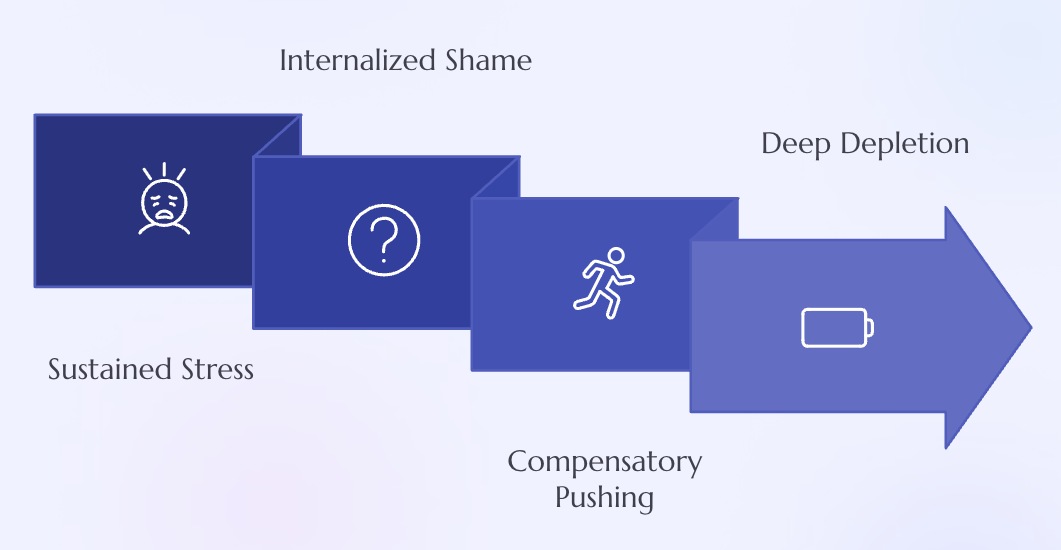
The 4 Stages of Burnout
The way I see burnout unfolding, from ongoing stress to deep depletion.
Sustained Stress
Too many demands, too little support.
Internalized Shame
Questioning self-worth: "What's wrong with me?"
Compensatory Pushing
Overriding signals, believing more effort is the answer.
Deep Depletion
Persistent exhaustion that rest can't fix.
Burnout doesn't arrive all at once. It builds quietly, often without us noticing until we're already deep in it.
There's a common pattern many people miss: stress turns into shame, and shame fuels the push that leads to burnout.
It often starts with a period of sustained pressure, too many demands, too little support, too much change all at once. That's stress. And stress alone doesn't create burnout. What makes it deepen is what happens next.
When we can't keep up with what's being asked of us, whether by work, family, or our own expectations, something changes. The stress becomes personal. We start to wonder: “Why is this so hard for me? Everyone else seems to be managing. What's wrong with me?”
That inner voice isn't neutral. It carries shame. And shame has a dangerous quality: it makes us push harder.
We tell ourselves we just need to try more, be better, do more. Rest starts to feel undeserved. Guilt creeps in when we pause. So we push. We override the signals: the exhaustion, the irritability, the weight. And that pushing, when there's nothing left to give, is what leads to burnout.
Not because we're weak. Because we were never taught to listen to what our bodies and minds were trying to say.
Catching It Earlier
The good news is that once you can see this pattern, you can begin to interrupt it. The most powerful place to step in is the moment stress tries to turn into shame.
When you notice that familiar voice asking “What's wrong with me?”, see if you can pause and ask a different question instead: “What is being asked of me right now? What do I actually need?”
This moment of awareness doesn't solve everything. But it creates a small gap between the pressure and your response. And in that gap, a different path becomes possible.
Explore Further
If you'd like to go deeper into this progression:
The Quiet Signs of Burnout
What Does Burnout Actually Feel Like?

Burnout doesn't usually announce itself with a dramatic collapse. It whispers long before it shouts. But when we're used to pushing through, it's easy to miss the early signals, or to mistake them for something we just need to override.
These signals show up differently for everyone. Sometimes in the body. Sometimes in mood. Sometimes in the quiet thoughts we barely notice.
Here are some of the ways burnout quietly makes itself known:
In The Body
A heaviness that doesn't lift, even after a full night's sleep
Tension that lives in your shoulders, jaw, or stomach, so familiar you've stopped noticing
Feeling physically drained while your mind races
In Mood
Irritability that catches you off guard, especially with people you love
Numbness where there used to be care or enthusiasm
A sense of moving through your days without really being present
In Your Inner World
Busyness without meaning, you're doing, but nothing feels satisfying
A quiet voice asking “What's wrong with me?” when you can't keep up
The growing belief that rest is something you need to earn
These aren't signs you're failing. They're signs you have been stretched for too long without enough support. They're messages worth listening to.
Sometimes the signs aren't loud. They show up in how we keep showing up, while slowly losing touch with ourselves along the way.
When Overfunctioning Hides What's Really Going on
One of the quieter ways burnout shows up is overfunctioning, showing up, holding things together, meeting expectations, while parts of you quietly go offline. You keep doing. You keep achieving. But inside, there's less and less of you present. This stage is easy to miss because from the outside, everything looks fine. But inside, you're running on a version of yourself that's becoming harder to recognise.
When Burnout Deepens
When burnout has been building for a long time, the signals become harder to ignore:
A sense of collapse, feeling like you simply can't anymore
Deep disconnection from yourself, others, or things that once mattered
The feeling that even small tasks require enormous effort
A quiet voice wondering if you'll ever feel like yourself again
These aren't signs you're weak. They're signs you have been carrying too much for too long.
Why We Miss The Signs
When you're used to performing, achieving, holding things together, it can feel dangerous to slow down long enough to notice what's actually happening. We learn to override. We keep going. And somewhere along the way, we lose touch with the very signals that are trying to guide us.
Catching burnout earlier doesn't mean you have to change everything at once. It starts with something quieter: learning to pause long enough to hear what your body and mind have been trying to say.
A Quick Self-Check: If you're wondering whether what you're experiencing might be more than everyday stress, this short self-check can help you pause and notice what's really going on: The 5 Signs Your Exhaustion Is Depletion, Not Stress.
Explore Further
If you'd like to go deeper into recognizing the early signs:
The Many Faces of Burnout
Why Does Life Feel Exhausting Even When Nothing Is "Wrong"?

Burnout doesn't look the same for everyone. What drains one person might barely register for another. That's because burnout is shaped by your circumstances, your history, and the quiet patterns that have become part of how you navigate the world.
The following are some of the ways burnout shows up. You may recognise yourself in one, or in several. There's no right way to experience it, only your way.
Burnout in the Expat Experience
Living abroad often looks like an adventure from the outside. But beneath the surface, there's a quieter toll: the constant adaptation, the loss of effortless belonging, the slow drift from who you were before you learned to perform “fine”.
You might feel grateful for the life you've built, while also carrying grief for what you left behind. Both can be true. And holding both, without a place to name it, can be deeply exhausting.
This kind of burnout isn't about too much work. It's about the quiet weight of building a life in a place that doesn't always feel like home.
Explore Further
The Weight of Internal Demands
Sometimes the hardest expectations aren't from the outside. They come from within. The voice that says you should be doing more, handling more, being more. The belief that rest must be earned, that your worth is measured by what you produce.
This internal pressure can be relentless. It doesn't give you a day off. And because it's coming from inside, it can feel impossible to escape.
But that voice isn't the truth. It's a pattern. And patterns can be understood, softened, and eventually, responded to with more kindness than criticism.
Explore Further
When Responsibility Exceeds Influence
One of the most draining situations is being accountable for outcomes you have little control over. You're trusted to deliver, but you don't have the authority to make the decisions that would help you succeed.
This creates a quiet, constant friction. You pour energy into something, but the levers you need are in someone else's hands. Over time, it stops feeling like a challenge and starts feeling like a trap.
If this sounds familiar, you're not imagining it. This isn't a sign you can't handle your role. It's a sign the structure itself is working against you.
Explore Further
The Exhaustion of Control
Many of us were taught that if we just plan enough, prepare enough, anticipate enough, we can keep things from falling apart. But life doesn't work that way. And the energy spent trying to control what you can't, other people's reactions, uncertain outcomes, the future itself, drains you in ways you may not even notice.
The exhaustion of control is subtle. It shows up as mental replay, rehearsing conversations, managing how others see you. It's the quiet tension of always being on alert that never really turns off.
Letting go isn't giving up. It's redirecting your energy toward what you can actually influence: your own choices, your boundaries, your wellbeing.
Explore Further
Finding Your Way Back
How Do I Begin to Recover From Burnout?

When you're deep in exhaustion, it's natural to want a way out. A clear path. A timeline. A promise that if you do X, Y, and Z, you'll feel like yourself again.
But healing doesn't usually work that way.
It's rarely a straight line. And it rarely announces itself with a dramatic breakthrough. More often, it shows up quietly. In moments you almost miss. In small changes that don't feel like progress until you look back.
What Healing Can Look Like
For many people, healing from burnout begins when the question changes.
Instead of asking “How do I get back to how I used to be?”, they start asking “What do I need to feel human again?”
This shift is crucial. The first question is about returning to an old version of yourself, one that was already drained. The second is about building something more sustainable.
Healing isn't about performing better. It's about relating to yourself differently.
The Quiet Signs of Healing
When you're in the middle of it, progress can be hard to see. But often, it shows up in subtle ways:
A pause before automatically acting on a "should" that once drove you.
Feeling boredom instead of panic during a quiet moment.
Setting a small boundary and feeling a spark of pride, not guilt.
Noticing a need (for hunger, rest, or comfort) and responding without judgment.
These moments don't announce themselves. But they're real. And they accumulate.
What Healing Is Not
Healing is not a return to who you were before. That version of you was surviving. The version that emerges from burnout has something different: awareness, boundaries, and a deeper understanding of what you need.
It's also not about never feeling stressed again. Stress is part of life. The difference is in how you meet it, whether you override it or listen to what it's telling you.
A Gentler Timeline
There's no set timeline for healing. It depends on how long you've been carrying more than was sustainable, what patterns kept you there, and how much support you have along the way.
What matters more than speed is depth. True change happens at the pace it needs to happen. And that's not a sign you're doing it wrong. It's a sign you're doing it honestly.
Explore Further
If you'd like to go deeper into what healing can look like:
The Rebalancing Practice
What Can I Do When I'm Depleted but Still Have to Work?

If burnout is a crisis of connection, to your needs, your limits, your own inner signals, then the way out isn't more effort. It's learning to listen differently.
This is the heart of the Rebalancing Practice. It's a simple, compassionate tool you can return to anytime you feel the old push-and-crash cycle starting up.
Three steps. That's all.
Notice the Signal
Your body speaks first. Exhaustion, irritability, anxiety, brain fog, these aren't character flaws. They're messengers.
The first step is simply to pause and acknowledge the signal without judgment. Not “What's wrong with me?” but “Ah, there's the tension in my shoulders. There's the heaviness.”
Name the Need
Translate the signal into what it truly represents. What core need is asking for attention?
Overwhelm might be pointing to a need for rest or space
Resentment might be telling you a boundary is needed
Emptiness might be asking for connection or meaning
You're not diagnosing. You're translating.
Choose the Smallest Step
You don't need to solve everything. Based on the need you named, what is the smallest, kindest action you can take right now?
It could be:
A five-minute pause
Delegating one task
Saying “not right now” to one request
Closing your laptop and stepping outside
Let this small step be your answer.
Why this Works
When you're burned out, your system needs one thing above all: to know it's safe to stop fighting.
The Rebalancing Practice doesn't ask you to do more. It asks you to pause, listen, and respond with the smallest gesture of care. Over time, these small moments accumulate. They rebuild trust with yourself. They teach you that your needs matter, not as a reward for doing enough, but simply because they're yours.
This practice isn't a quick fix. It's a return. A way of coming back to yourself, one small moment at a time.
The Rebalancing Practice (Notice → Name → Choose) is one part of how I support lasting change. For those ready to go deeper, the REBALANCED me Path offers a compassionate way to move from awareness to integration.
Explore Further
If you'd like to explore the Rebalancing Practice in more depth:
Practical Tools to Start Today
Why Doesn't Rest Make Me Feel Rested?

You don't need to change everything at once. Small shifts, practiced with consistency, can begin to change the way you move through your days.
Here are a few tools to try. Take what resonates. Leave what doesn't.
Micro-Rests
Instead of waiting until you're completely drained, try pausing for one to five minutes throughout the day. No agenda. No phone. Just a moment to let your system settle.
A micro-rest might be:
Standing by a window and watching the light change
Closing your eyes and taking three slow breaths
Sitting somewhere quiet with a cup of tea
You're not hiding from your responsibilities. You're giving yourself what you need to meet them with more of yourself present.
The Language Shift: From “I have to” to “I let myself be”
Listen to how you speak to yourself. Notice how often “I have to” shows up.
Now try an experiment. Instead of:
I have to go to bed → I let myself rest
I have to leave this gathering → I let myself stop for the evening
I have to stop working → I let myself be complete for today
The task doesn't disappear. But the weight you carry around it can soften.
The Energy Audit
Take a few minutes to notice where your energy actually goes. List your main responsibilities, across work, home, and life. Then ask two questions for each:
What impact does this have on my wellbeing?
What does this cost me in energy?
Often, you'll find places where you're spending high energy for low return. Those are the spots worth renegotiating, whether that means delegating, adjusting expectations, or simply acknowledging the cost.
The 5-Minute Check-In
At some point in your day, pause and ask yourself:
What am I feeling in my body right now?
What do I actually need at this moment?
What's one small thing I can do to offer myself that?
You don't have to solve anything. Just check in. The act of turning toward yourself is the practice.
Explore Further
If you'd like to go deeper into these tools:
When to Seek Support
When Do I Need More Than Self-Help?
The tools and insights in this guide are here to support you. But there may come a time when self-guided work isn't enough, and that's not a failure. It's a sign of self-awareness.
You don't have to figure it all out alone.
How to know if you might need more support
There's no single sign that means it's time to reach out. But here are a few things to notice:
You've been feeling exhausted for months, and nothing seems to change
You're using all the tools you know, but still feel stuck
Your relationships, work, or daily life are feeling harder to manage
You're experiencing persistent physical symptoms, sleep changes, appetite changes, tension that won't release
The thought of slowing down feels unsafe or impossible
If any of this resonates, it may be worth speaking with someone who can offer more than information, someone who can sit with you, help you make sense of what's happening, and support you as you find your way through.
What working together can look like
If you're curious about what support might look like, I invite you to explore the REBALANCED me Path.It's a compassionate, structured process for moving from stress and disconnection towards greater clarity and alignment, at your own pace.
We start with a free Intro Call. No pressure, just a conversation to see whether working together feels right.
You're not behind. You're not failing. You're just in a part of the journey that's asking for something different.
If you're recognising yourself in what you've read and you're navigating burnout or deep exhaustion as a tech expat, you don't have to work through it alone. I offer 1:1 coaching and counselling for tech expats, online and in English and in Arabic.
If you'd like to talk, I'm here.
Free 45-minute conversation. No preparation. No pressure.

A Little About Me
I'm Mena. I spent over 25 years in tech before finding my way into coaching and counselling. Today, through Rebalanced me with Mena, I support people who are feeling exhausted, overwhelmed, disconnected from themselves, or simply no longer able to keep going in the way they have been.
I created this guide because I know how easy it is to keep going without stopping to ask what is really happening underneath.
If you'd like to know more about me, you can read my story here.
I hope something in this page helped you see yourself a little more clearly, and perhaps gave you permission to slow down, listen to yourself, and be a little gentler with yourself.
Thank you for being here.