
Why Year-End Fatigue Hits So Hard
You can ignore your stress for months. But your body never does. What does your body remember about this year that your mind is trying to forget?
That deep end-of-year fatigue isn't just in your head. It's the accumulated cost of 12 months of showing up.
That push for "closure" or celebration? It can feel like just another demand on your endless to-do list. The pressure to look back on the year only brings up a mental list of everything you didn't get done.
If you're feeling deeply tired, irritable, or just numb when the world expects cheer, please know this: You are not alone, and you are not failing.
You're not failing at "balance." You're experiencing the real cost of a year's worth of stretching, through deadlines, decisions, constant demands, and showing up, even on the days you didn't feel like it.
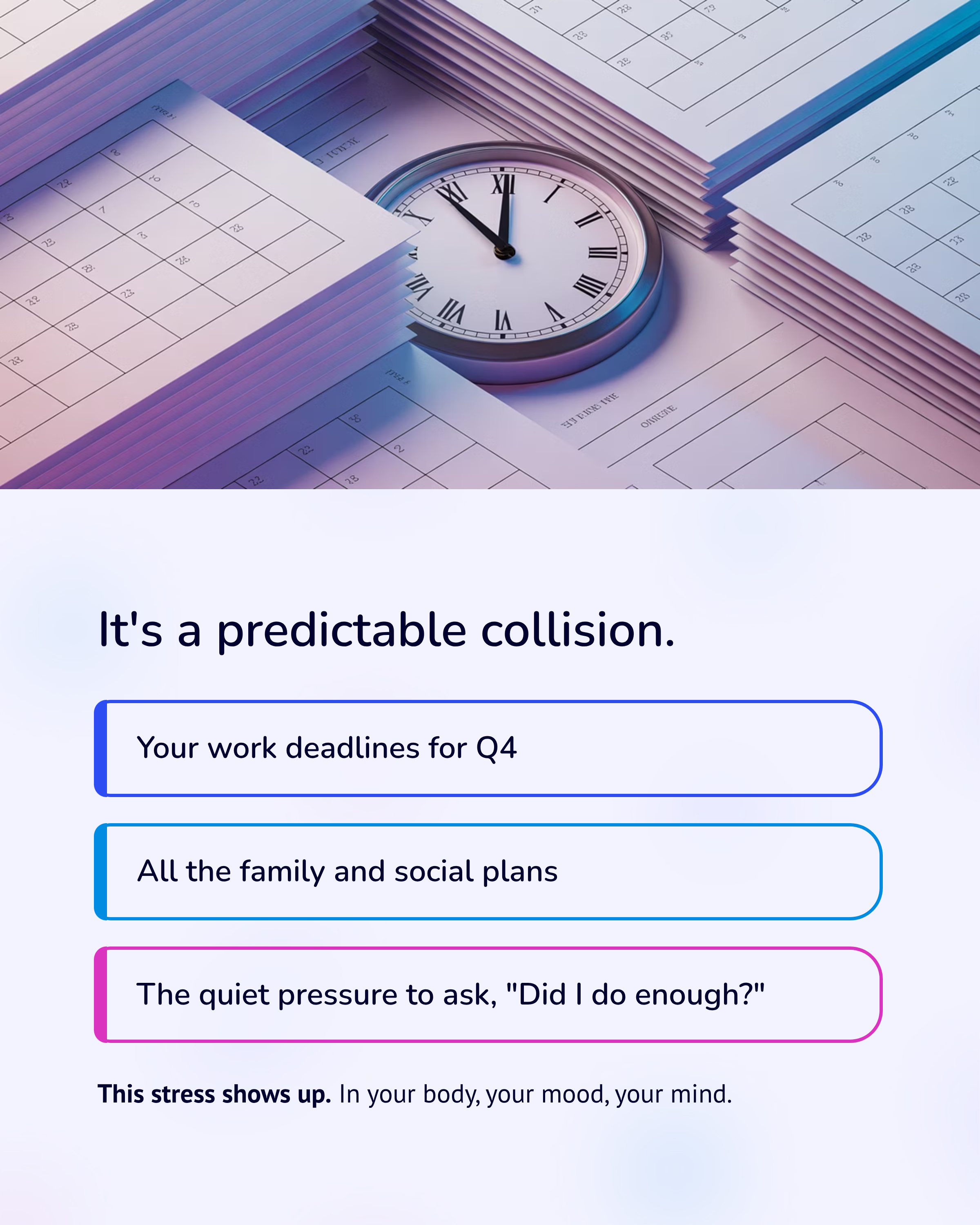
This exhaustion isn't a personal flaw. It's a predictable collision:
Your work deadlines for Q4.
All the family and social plans.
The quiet, internal pressure to ask, "Did I do enough this year?"
It all arrives at once. When you're already running on empty, this extra load doesn't feel like celebration. It feels like a demand you can't meet.
This kind of stress doesn't just stay as a thought. It shows up. You feel it:
In your body: As that heavy tiredness that a third cup of coffee won't fix, or a tightness in your neck and shoulders.
In your mood: As an inability or a short temper with loved ones, low motivation, or a flat feeling where there "should" be joy.
In your mind: As brain fog when you try to focus, or that critical whisper: "Why is this so hard for me?"
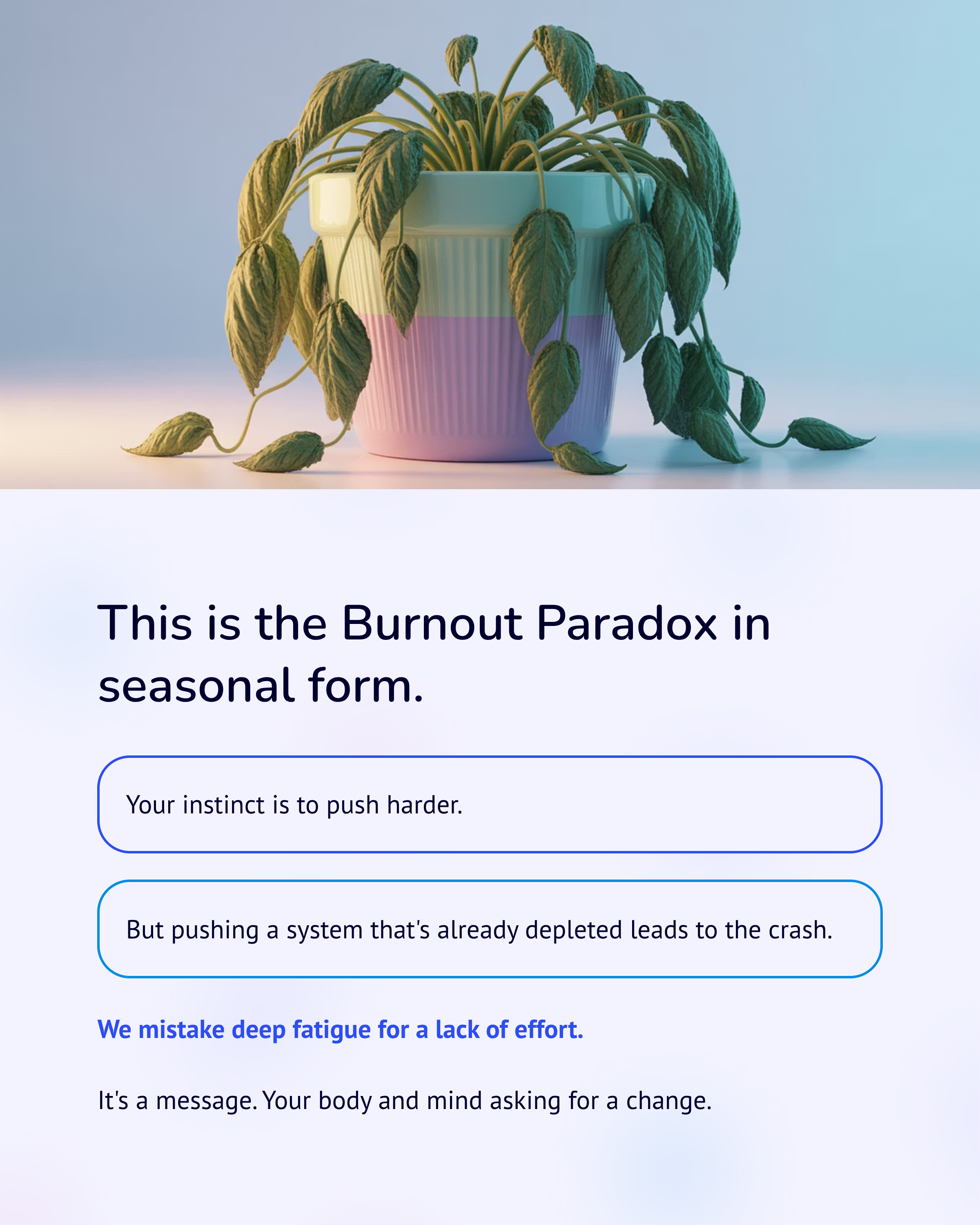
Pushing against this fatigue doesn't help. It's like denying water to a thirsty plant because you're frustrated it's not blooming fast enough, it only makes things worse.
Recognizing this isn't about finding a label for yourself. It's about validating your experience, saying, “This is real. What I'm feeling makes sense.” It's giving yourself permission to respond with kindness, not more pressure.
This is the first step: seeing your exhaustion not as a character flaw, but as a valid sign that you've been stretched for too long.
This is why year-end fatigue hits harder than ordinary tiredness.
Why This Fatigue Feels Different
This isn't ordinary tiredness. It’s the Burnout Paradox in seasonal form.
Your instinct, when you hit this wall of demands, is likely to push harder. To tell yourself, “Just push through until the end-of-year or the holidays.” But pushing a system that's already depleted is what leads to the crash.
Let's trace how it often happens:
The stress of “I have to get everything done” quietly twists into a story: “Why can't I handle this? Everyone else seems fine.”
That story of not being enough fuels guilt.
The guilt makes us push even harder.
We push until we hit the wall, a state of total exhaustion.
We mistake this deep fatigue for a lack of effort or discipline. But it's not. It's a message. It's your body and mind asking for a change.
Your Invitation: The Gentle Noticing Practice
This week, your practice is simple observation. We are not adding “fix my fatigue” to your to-do list.
Instead, try this gentle experiment:
As you move through your days, simply notice:
What one year-end task or event actually drains you?
Can you spot what, even for a moment, gives you a trace of genuine warmth or peace?
No need to change anything. Just collect the data.
Pay attention to how the stress speaks to you. Does your shoulder tighten when you think about that big gathering at the office? Do you feel irritable with a loved one after scrolling through social media? Just name it softly: “Ah, there’s the overwhelm, showing up as a headache.”
This isn’t about fixing. It’s about noticing. That simple act creates a tiny space between you and the stress. In that space, a kinder response can begin to grow.
This is the first step of tuning in: discovering what you actually need this season, separate from what you believe you should be doing.
Disclaimer: This content is for informational purposes only. It is shared to promote awareness and understanding, not to replace professional medical or psychological advice. If you are experiencing persistent symptoms of depression or anxiety, please consult a healthcare provider.
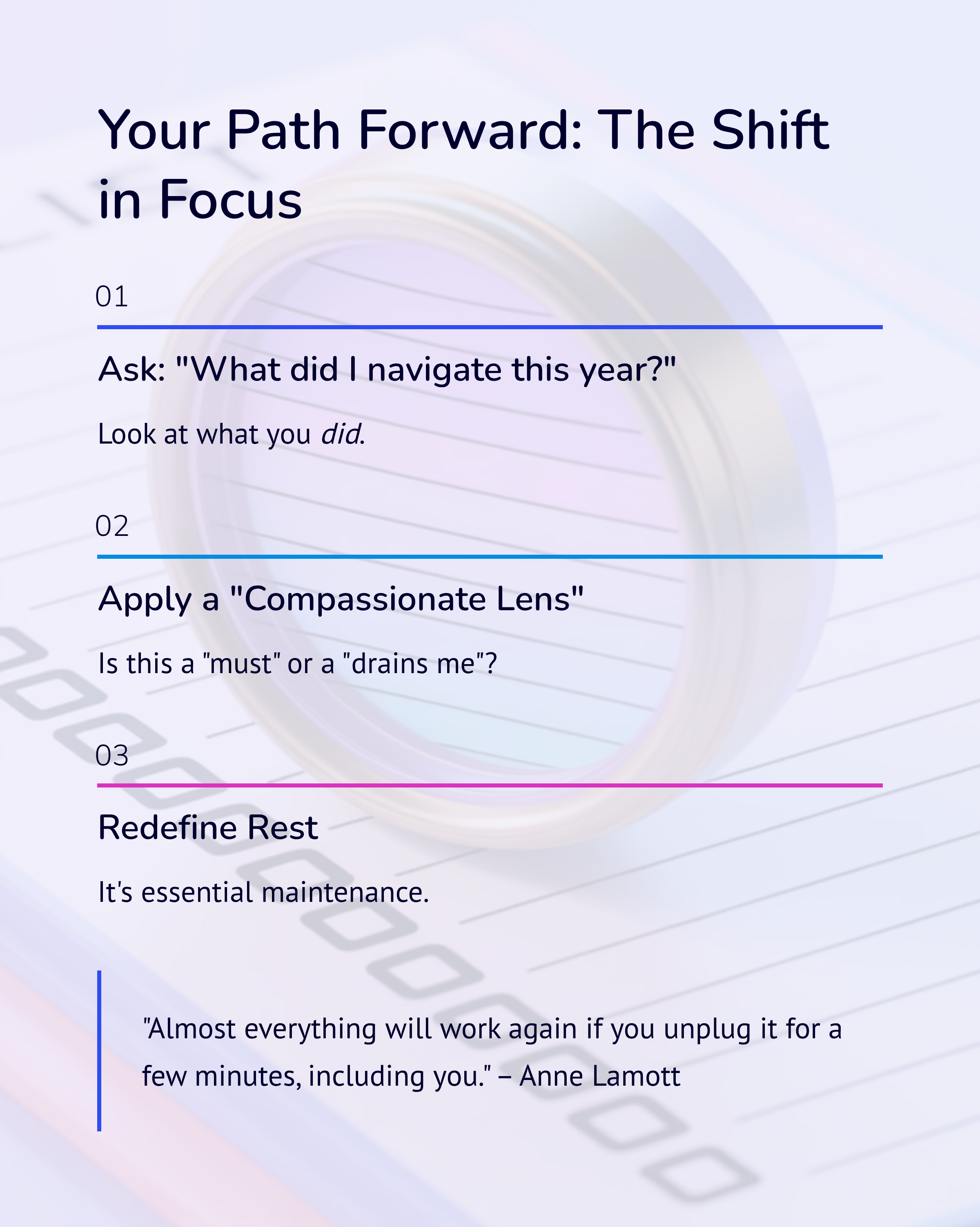
Your Path Forward: The Shift from What's Left to What You Did
You don't have to cancel everything or magically find more hours in the day. The way through is a shift in focus, from criticism to compassion.
Reframe Your Year-End Review: Instead of the mental list of everything you didn’t do: "I didn't achieve X," try a kinder question: “What did I navigate this year?”
You made it through another 12 months of challenges, changes, and demands. You kept going. That, in itself, is a significant achievement. Then, get specific and small. Ask yourself:
“What are three small ways I cared for myself or someone else this week?”Did you make a warm drink? Take five minutes just to pause? Send a kind text to a friend?
Look at what you did. This shifts your focus from the unfinished to the accomplished, from criticism to acknowledgment.
Apply a “Compassionate Lens” to End-of-Year Demands: Look at your commitments. For each one, ask: Is this an absolute "must," a "I'd like to," or a "This drains me"? Give yourself permission to modify one thing. Could a gift be a simple, meaningful note instead? Could you attend a gathering for just one hour? Choosing one boundary isn't failure, it's a profound act of self-care.
Redefine Rest as Essential, Not Guilty: Rest isn't a luxury you earn after everything is done. It's the essential maintenance that lets you do anything at all. The writer Anne Lamott offers a beautiful perspective: “Almost everything will work again if you unplug it for a few minutes, including you.” That evening you keep for yourself is you unplugging or hitting pause. It's not hiding from it all, it's recharging so you can be present for the parts that truly matter to you.
Remember, the goal isn't a perfect, stress-free end-of-year.
The goal is to move through this time with more kindness toward yourself than criticism. It's about listening to your fatigue as a call to be gentle, not a proof that you're doing it wrong.
So, try shifting the question you ask yourself.
Instead of: "How can I get everything done?"
Try asking: "What is the kindest, most sustainable way through this?"
Your answer might be:
Setting a boundary on one social event.
Delegating one task.
Giving yourself permission to do nothing for 20 minutes, without guilt.
This is how you build a gentler season, one small, conscious choice at a time.
If this resonates…
If you're feeling lost in this cycle of year-end pressure and want to build a sustainable way of living that honours your energy, this is the work we do together. You don't have to figure it out alone. Send me a message and tell me one thing you noticed, I'm here to help.
