
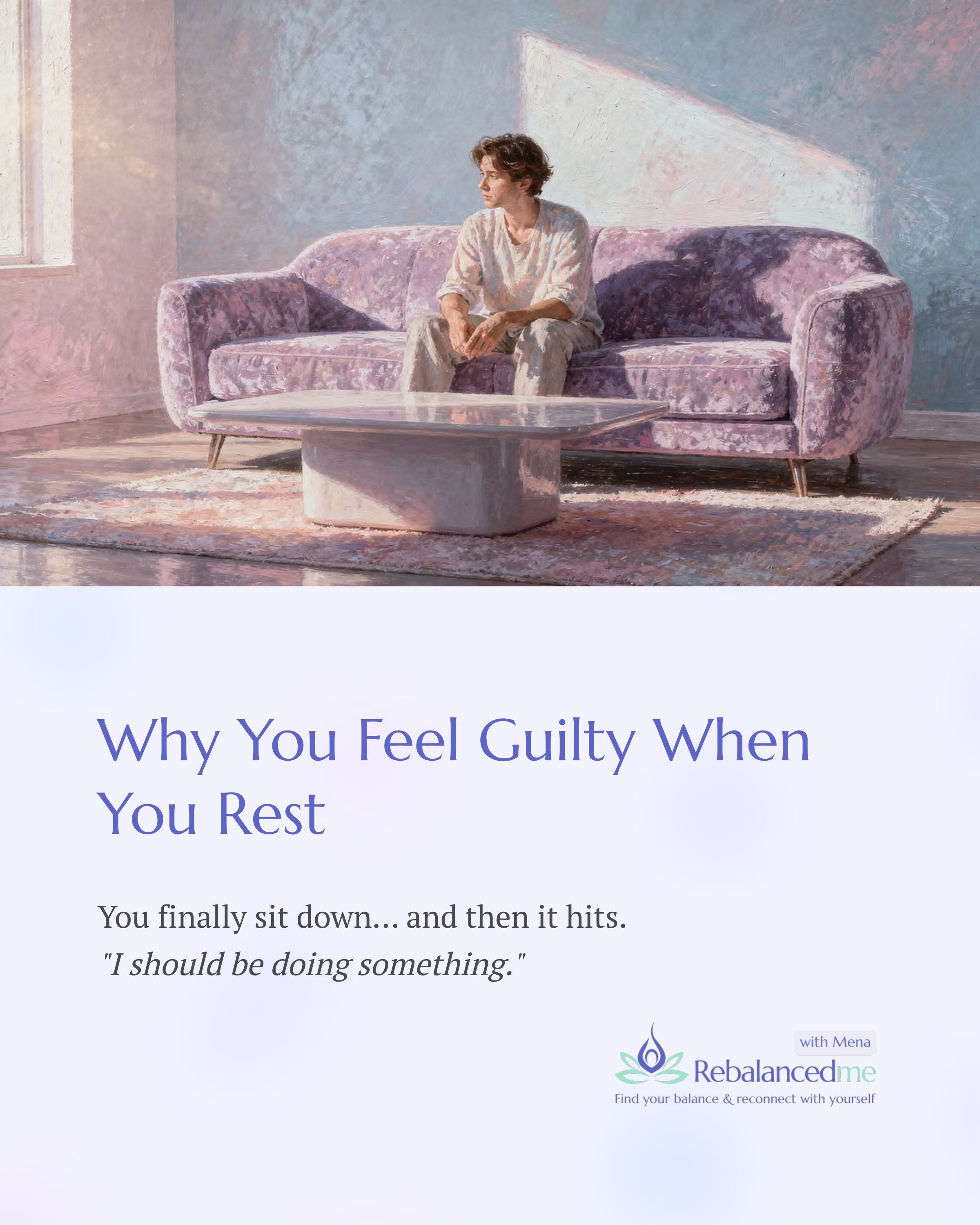
Why You Feel Guilty When You Rest
You finally take a break. You sit down, breathe, try to rest. And then it hits you: the guilt “I am wasting my time”, “I should be doing something”.
The whisper that says you should be doing something. That you're falling behind. That rest is something you have to earn, not something you're allowed to simply take.
If this feels familiar, please hear this: You're not lazy. You're not failing.
You've just been taught, by culture, by upbringing, by a world that never stops, that your worth is measured in output.
What follows is an invitation to understand where that guilt comes from. Not to shame yourself for it, but to listen to what it might actually be trying to tell you.
Where Work Guilt Comes From
Productivity Culture's Invisible Message
We're raised in a world that equates doing with value. From school grades to performance reviews, the message is consistent: You are what you produce.
Over time, this message becomes internalized. You don't need anyone to tell you to work, you tell yourself. And when you stop, the silence fills with guilt.
Childhood Roots: What You Learned Before You Started Working
For many of us, the roots go deeper.
I remember sitting in my therapist's office, years ago, genuinely surprised when she said: “Weekends are for rest. For doing things just for you. Not for being useful.”
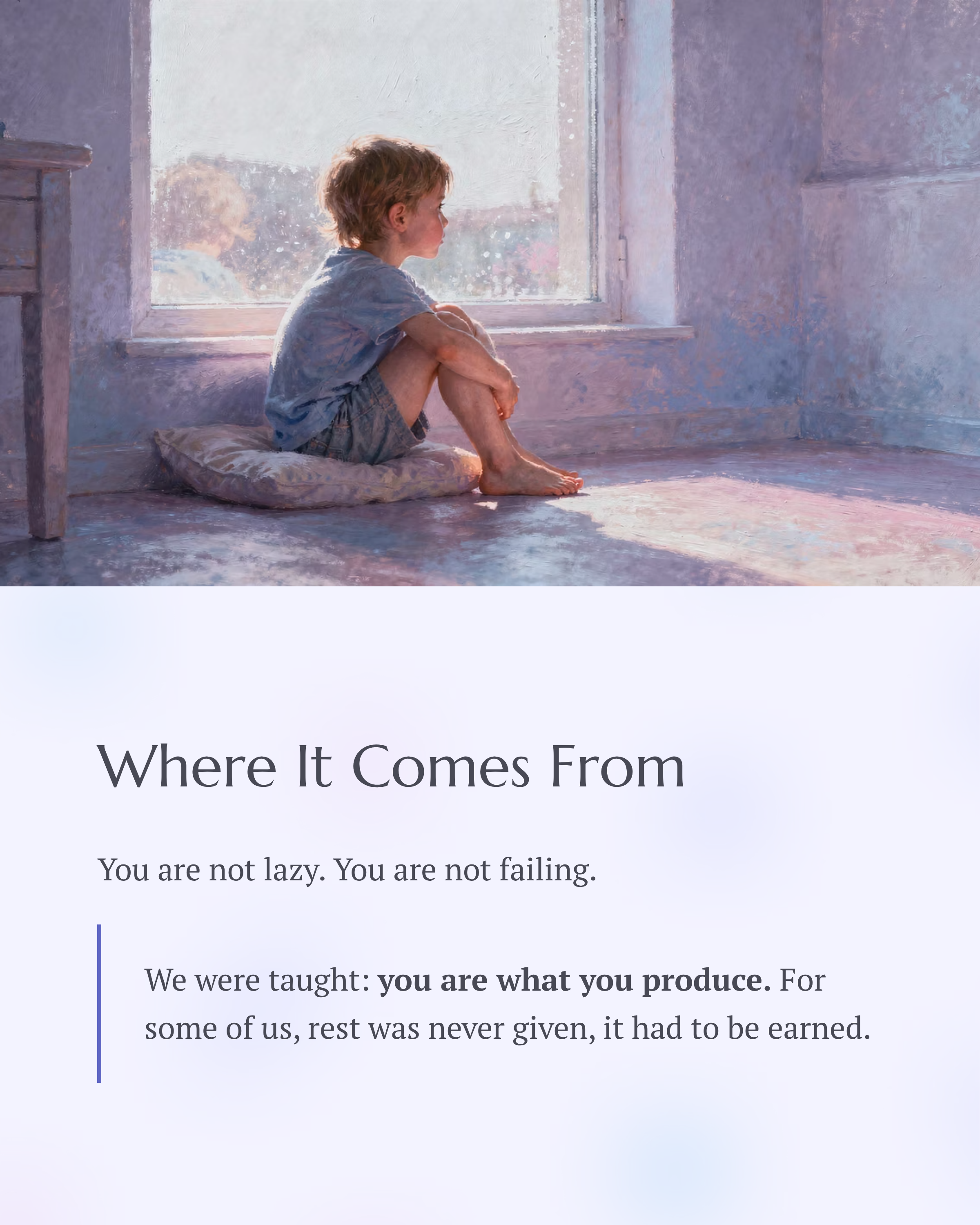
As a child, I wasn't allowed to simply be. There was always a responsibility, a task, something “useful” to fill the time. Play wasn't a priority. Rest wasn't a given. And that voice, you should be doing something, followed me into adulthood.
If this sounds familiar, you’re not alone. Many of us learned, long before we entered the workforce, that our value was conditional on being productive.
When Your Job Becomes Your Identity
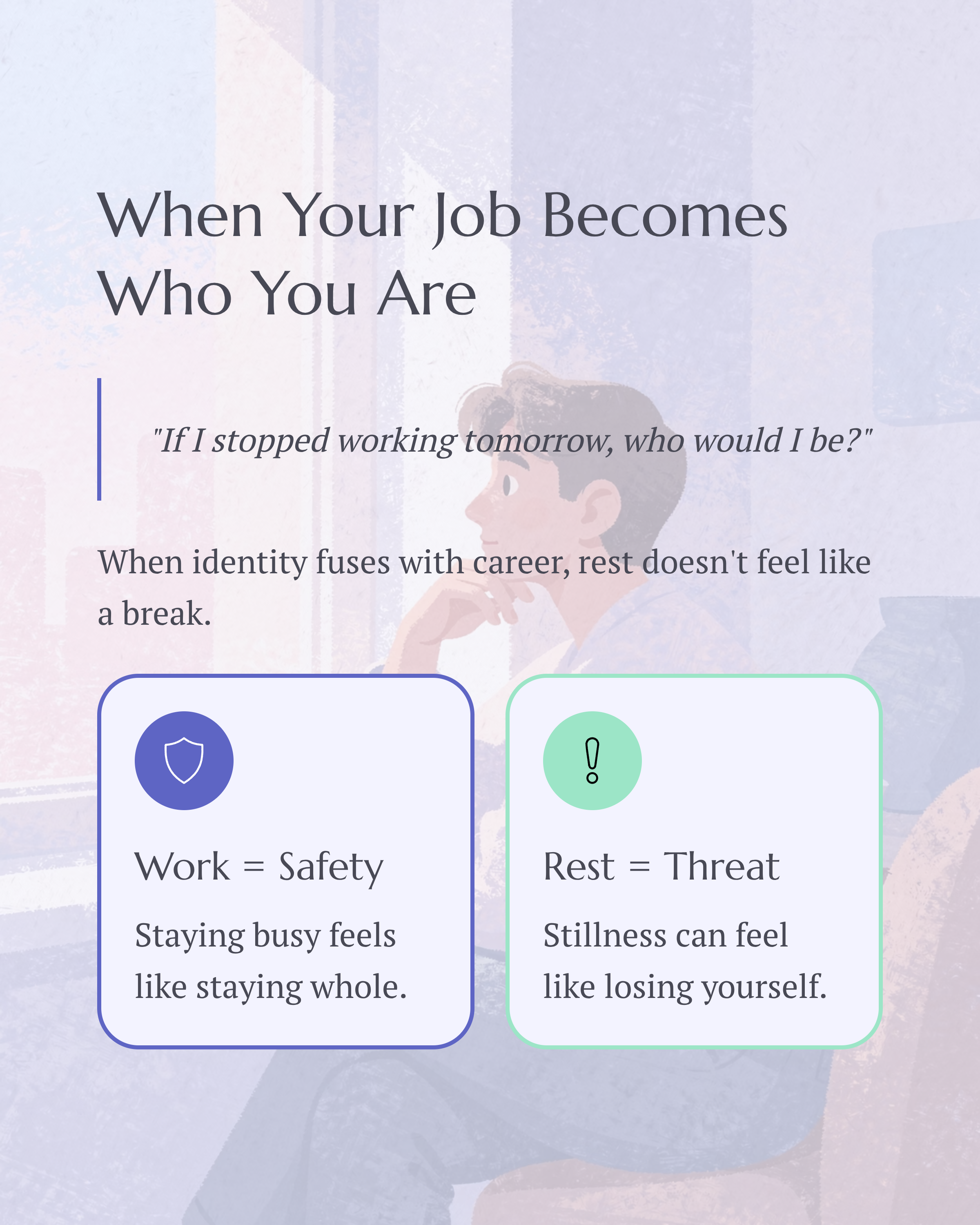
There's a question we rarely ask: If I stopped working tomorrow, who would I be?
For many high-achievers, the answer feels unsettlingly blank. We become so diluted in our roles, manager, leader, expert, that we forget we're also partners, friends, humans with hobbies and hearts.
When your identity is fused with your career, rest doesn't feel like a break. It feels like a threat. A small death. No wonder guilt shows up.
The Two Paths: High Achiever on the Outside, Suffering Human Within
There's a particular pain that comes with living two parallel lives.
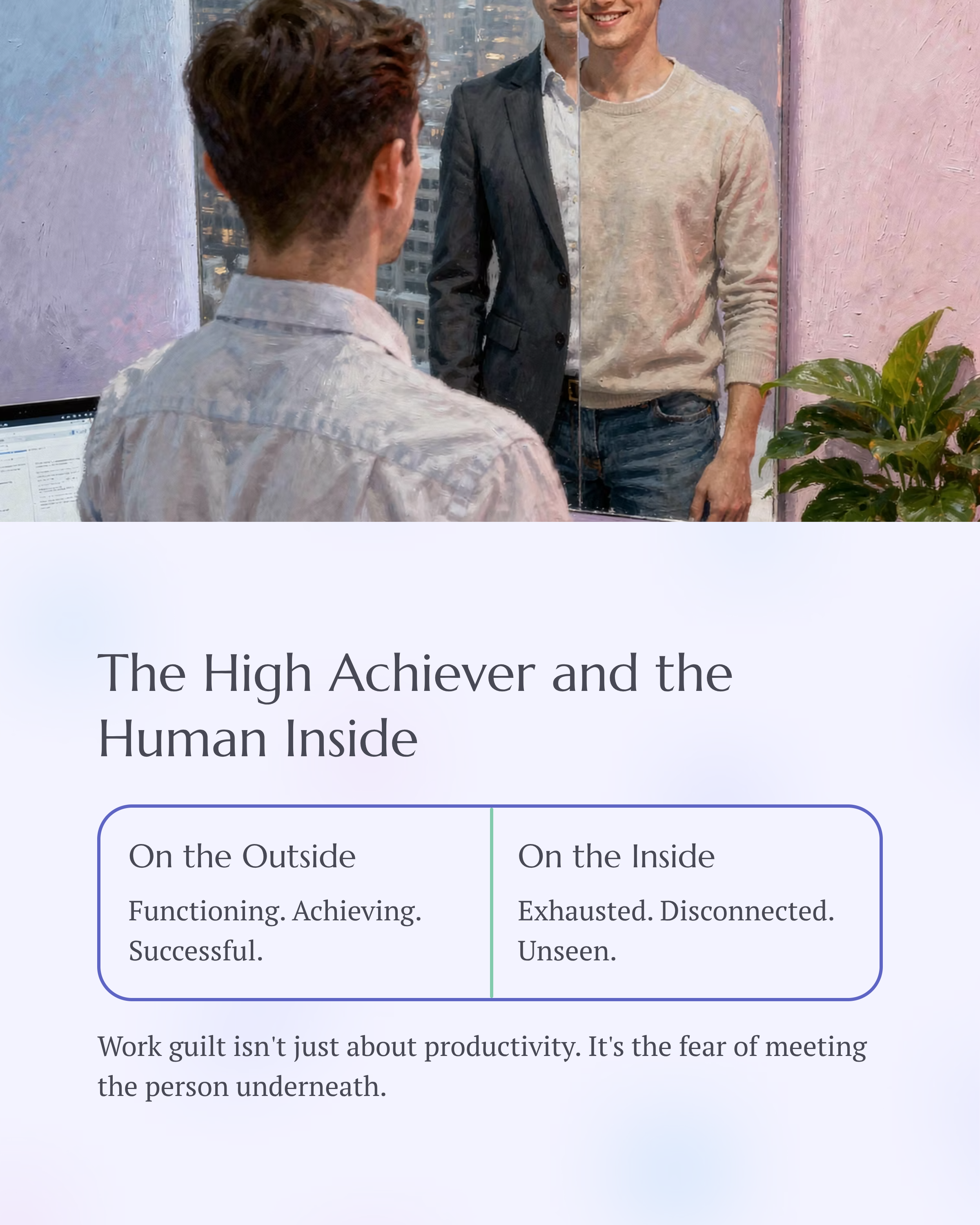
On the outside, you're functioning. Achieving. Maybe even highly successful. On the inside, there's a different story: exhaustion, disconnection, a quiet sense of being a stranger to yourself.
This is what someone I worked with described as feeling “imprisoned inside self.” The high achiever runs the show, while the human underneath grows quieter, lonelier, more unseen.
Work guilt, in this context, isn't just about productivity. It's the fear that if you stop running, you'll have to meet the person inside. And you're not sure you know who that is anymore.The Stress-Shame-Burnout Cycle
This is where the progression we've explored before shows up again:
Stress → Shame → Burnout → Depression
Stress alone doesn't break us. It's when stress turns into shame, “Why can't I handle this?
Everyone else seems fine”, that we start pushing harder. And the guilt about resting? That's the fuel keeping the cycle alive.
What Your Guilt Is Really Trying to Tell You
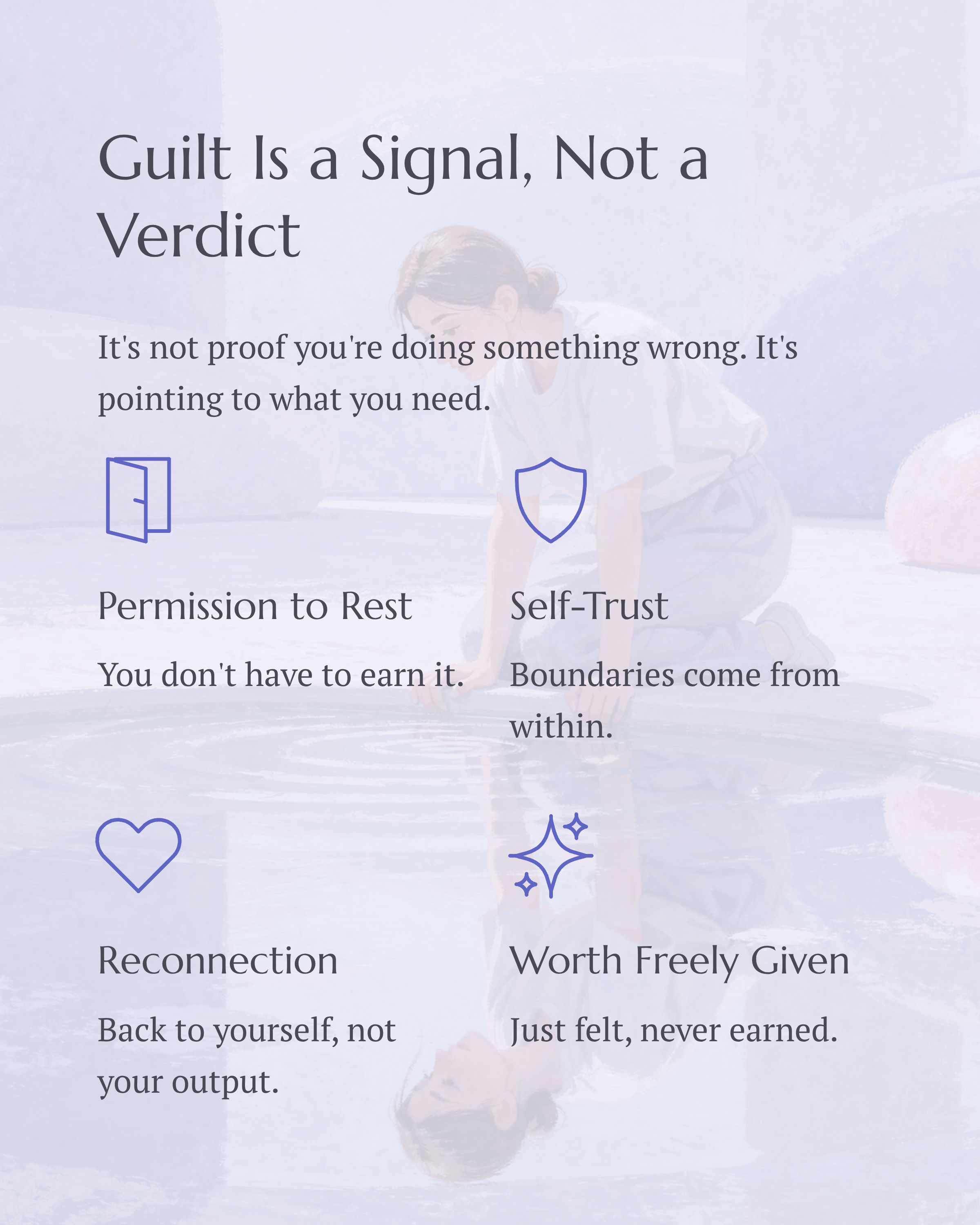
Here's a different way of seeing it: Guilt isn't a verdict. It's a signal.
It's not proof that you're doing something wrong. It's information, pointing toward something you need.
If guilt shows up when you rest, it might be pointing to a need for permission, to unlearn old messages that said rest wasn't allowed.
If guilt shows up when you set a boundary, it might be pointing to a need for self-trust, to believe that your needs matter too.
If guilt shows up as a constant background hum, it might be pointing to a need for reconnection, with the parts of you that exist outside of work.
If guilt shows up when you're not “achieving,” it might be pointing to a need for worth that isn't earned, just felt.
Guilt, in this light, isn't the enemy. It's a messenger. And messengers, however uncomfortable, deserve to be heard.
New Perspectives and Small Practices
Notice, Don't Fight
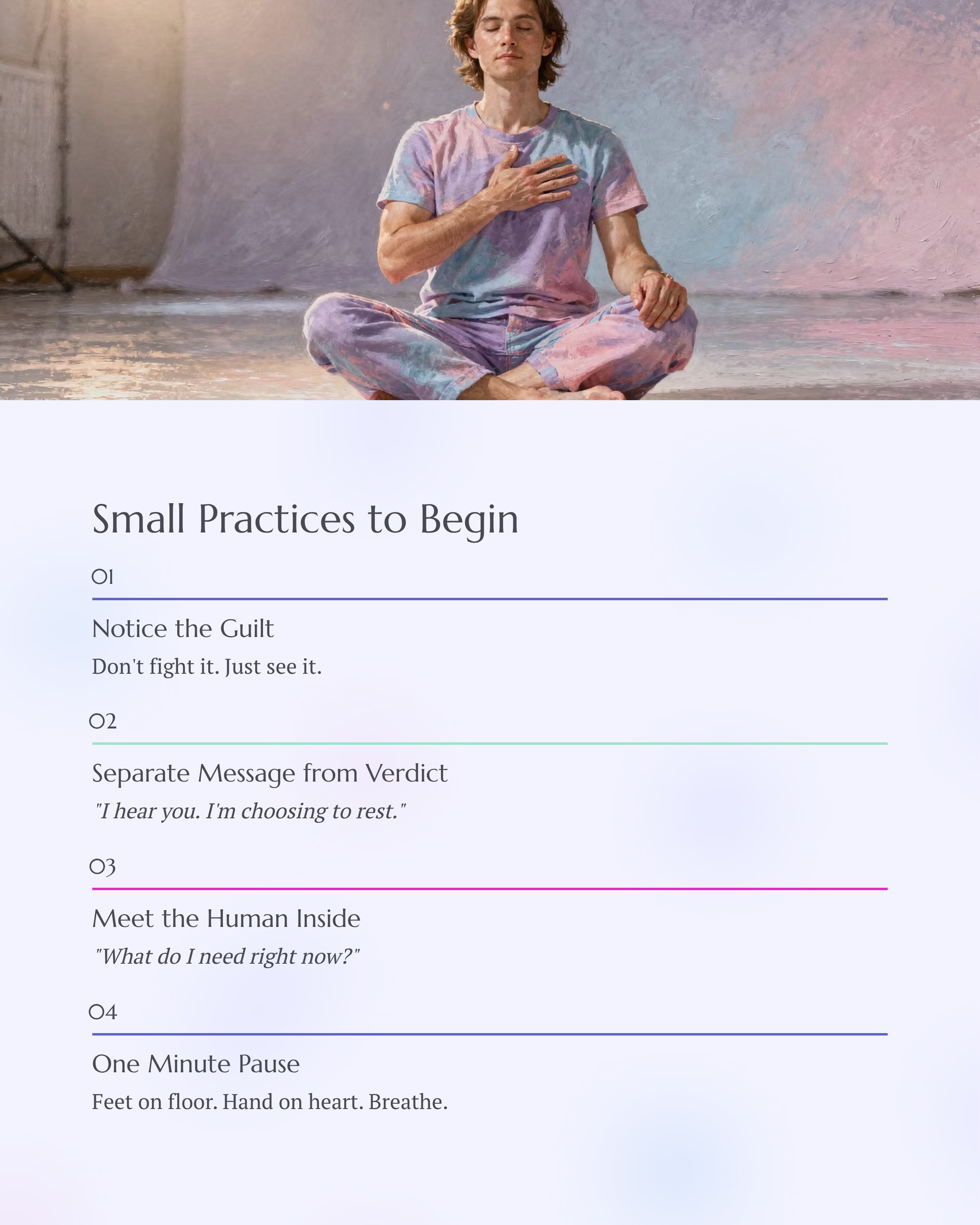
When guilt arises, try not to push it away. Just notice it. “Ah, there is the guilt. It's telling me I learned that rest isn't safe.” Naming it reduces its power.
Separate the Message from the Verdict
Guilt says: “You should be working.”
You can respond: “Thank you for the message. I hear you. And right now, I'm choosing to rest.”Meet the Human Underneath
The person inside, the one who's been running for so long, needs more than achievement.
They need presence. Kindness. Acknowledgment.
This week, try asking yourself: “What does the human inside me need right now? Not the achiever. The human.”
Practice the “Pause”
You don't need to fix everything. Just pause for one minute. Feet on the floor. Hand on heart.
Breathe. Say to yourself: “I am allowed to be here, without producing anything.”
That one minute is a small act of rebellion against a world that wants you always on.
Remember: You Are Not Your Output
You are not the sum of your completed tasks. You are not your job title. You are not what you produce.
You are a person. With a body that needs rest. A heart that needs connection. A spirit that needs space.
And none of that has to be earned.
Your Invitation to Listen Differently
This week, when guilt arrives, and it will, try pausing instead of panicking. Just notice it. Ask gently: “What are you trying to tell me?”
Not to argue with it. Not to fix it. Just to listen.
The answer might surprise you. It might be simpler than you think: “I need rest.” Or “I need to feel like I matter outside of work.” Or “I need to meet the part of me I've been leaving behind.”
Your Way Forward: A Gentle Practice
Over the coming weeks, consider returning to this question whenever guilt feels heavy:
“If I weren't trying to prove my worth through work, what would I do with this moment?”
The answer might be: rest. Connection. Silence. Play. Nothing at all.
None of these need to be earned. They're yours, simply because you're human.
If this resonates…
If you recognized yourself in these words, the guilt, the running, the quiet sense of being two people at once, please know: you're not alone. And you're not behind.
You're simply carrying messages that were never yours to hold. And noticing them, gently, is the first step toward setting them down.
If you'd like support as you navigate this, learning to rest without guilt, to meet the human inside, to rebuild a sense of self beyond achievement, I'm here. No pressure, just presence.
