
The Journey of Change: Understand Why Change Isn't Linear
Change Doesn't Happen in a Straight Line
Change is rarely as simple as deciding what you want to do differently and then doing it.
You may understand something about yourself one day, feel hopeful about changing it the next, and then find yourself right back in an old pattern a week later. You might feel frustrated, wonder why you're not further along, or even start believing that something is wrong with you.
This journey is a way of making sense of those ups and downs.
Most importantly, this isn't a journey you complete once and leave behind. You can move forward, move back, pause, revisit something you've already worked through, or experience several points at the same time.
The aim isn't to reach a point where you never struggle again.
It's to understand yourself differently, relate to yourself differently, and have more choice in what you do next.
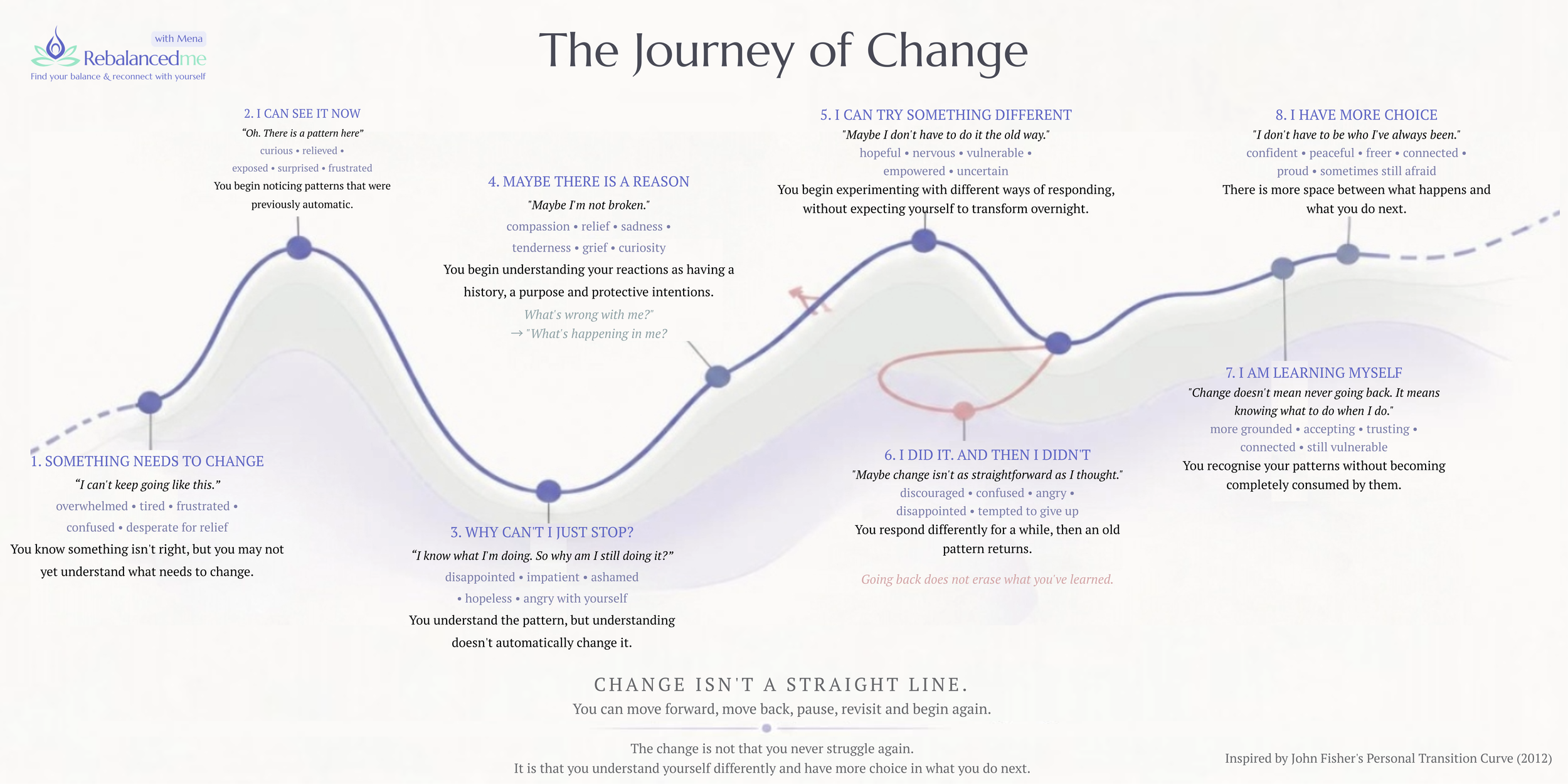
Your Journey of Change
1. Something needs to change
“I can't keep going like this.”
You know something isn't right, but you may not yet understand what needs to change.
You may think:
“Why am I like this?”
“I just want to feel normal again.”
“Something has to change.”
“I don't even know where to start.”
You may feel:
overwhelmed
tired
frustrated
confused
desperate for relief
You may also feel hopeful: maybe finding support will finally make things different.
2. I can see it now
“Oh. There is a pattern here.”
You know something isn't right, but you may not yet understand what needs to change.
You may think:
“I didn't realise I always do that.”
“Now that I see it, I can't unsee it.”
“Why do I keep doing this when I know it's not helping me?”
You may feel:
curious
relieved
surprised
exposed
frustrated
And sometimes more frustrated than before, because awareness doesn't automatically create change.
3. Why can't I just stop?
“I know what I'm doing. So why am I still doing it?”
You understand the pattern. You've talked about it. You may even know what you should do differently.
But then you find yourself doing the same thing again.
You may think:
“I thought I had worked through this.”
“Why am I still reacting like this?”
“I should know better by now.”
“Maybe I can't change.”
You may feel:
disappointed
impatient
ashamed
hopeless
angry with yourself
This is often where desperation of yourself appears. But this isn't necessarily evidence that you're failing.
It can be the point where you begin to discover that understanding yourself and changing your patterns are two different parts of the journey.
4. Maybe there is a reason
“Maybe I'm not broken.”
Instead of asking “What's wrong with me?”, you begin asking “What happened to me?” or “What is this part of me trying to do?”
You start seeing your reactions as having a history and a purpose.
Maybe the overworking helped you feel safe.
Maybe pleasing others helped you belong.
Maybe staying in control helped you cope.
Maybe disconnecting helped you survive something that felt too much.
You may think:
“This actually makes sense.”
“I've been trying to protect myself.”
“I didn't choose this consciously.”
“Maybe I can understand myself instead of fighting myself.”
You may feel:
compassion
relief
sadness
tenderness
grief
curiosity
This can be a profound shift: from “What is wrong with me?” to “What is happening in me?”
5. I can try something different
“I know what I'm doing. So why am I still doing it?”
You start experimenting.
Not transforming yourself overnight. Not becoming a completely different person.
Just trying something slightly different.
You pause instead of reacting.
You say no.
You ask for what you need.
You rest without earning it.
You notice an anxious thought without immediately acting on it.
You listen to yourself before looking outside yourself for the answer.
You may think:
“What would happen if I didn't do what I always do?”
“I could try this.”
“Maybe I don't have to fix this immediately.”
You may feel:
hopeful
nervous
vulnerable
empowered
uncertain
Sometimes it works.
Sometimes it doesn't.
6. I did it. And then I didn't.
“Maybe change isn't as straightforward as I thought.”
You have moments where you respond differently. You notice yourself sooner. You make a different choice. And then something happens.
You're stressed.
You're tired.
Someone triggers you.
An old fear comes back.
Suddenly you're doing the old thing again.
You may think:
“I'm back where I started.”
“See? I haven't changed.”
“I knew I couldn't do it.”
“Why does this keep happening?”
You may feel:
discouraged
confused
angry
disappointed
tempted to give up
But this stage is where an important realisation can emerge:
Going back to an old pattern doesn't erase what you've learned.
You may actually be noticing it earlier, recovering faster, or having more choice than you did before.
7. I am learning myself
“Change doesn't mean never going back. It means knowing what to do when I do.”
You begin to recognise your patterns without immediately becoming consumed by them.
You may think:
“I'm doing it again.”
“Something is happening inside me.”
“I need to pause.”
“I know this place.”
“I can come back.”
You may feel:
more grounded
more accepting
more trusting
still vulnerable
increasingly connected to yourself
The old response may still appear.
But your relationship with it has changed.
8. I have more choice
“I don't have to be who I've always been.”
You begin experiencing a different kind of freedom. Not because difficult emotions disappear.
Not because you never overwork, worry, people-please, withdraw, control or doubt yourself again.
But because there is now a little more space between what happens and what you do next.
You may think:
“I have a choice here.”
“I can listen to myself.”
“I don't have to abandon myself to keep someone else happy.”
“I can handle this differently.”
“I trust myself more than I used to.”
You may feel:
confident
peaceful
freer
connected
proud
sometimes still afraid
And then life happens again. You may find yourself back at “Something needs to change”, or “Why can't I just stop?” And that's okay.
You Don't Move Through These Stages Once
You can move forward, go backwards, skip a stage, stay somewhere for a while, or revisit something you thought you had already worked through.
The change is not: “I never struggle with this anymore.”
The change is: “I understand myself differently. I relate to myself differently. And I have more choice than I used to.”
Questions for Reflection
Where do you recognise yourself on this journey right now?
What tells you that you're there?
What are you feeling in this place?
What are you telling yourself about being here?
Have you been here before?
What helped you move through it last time?
Inspired by John Fisher's Personal Transition Curve (2012).
The language and focus have been adapted to reflect the kind of inner change I explore with clients.